

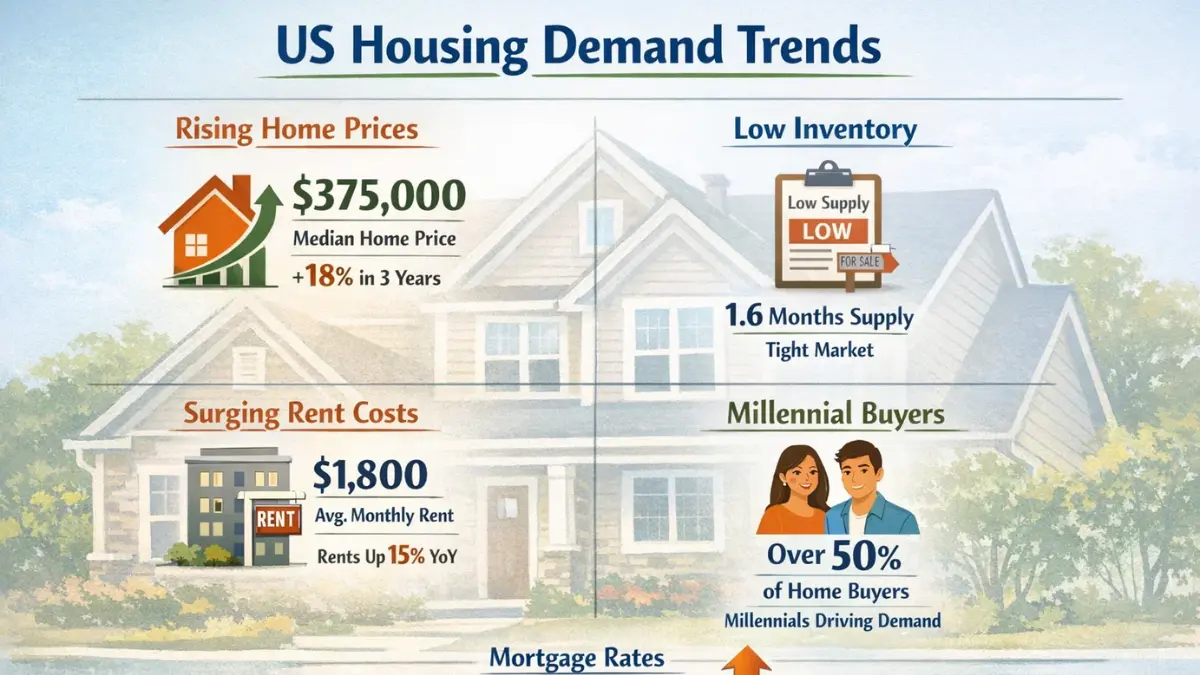
The U.S. housing market continues to evolve as economic conditions, mortgage rates, and demographic shifts reshape buyer behavior. Housing demand in 2025–2026 reflects a mix of resilience and caution, with strong underlying interest in homeownership but ongoing affordability challenges.
For buyers, understanding current demand trends can help with timing decisions, pricing expectations, and negotiation strategies.
Demographic Drivers of Demand
One of the strongest forces behind U.S. housing demand is demographics.
Millennials remain in their prime homebuying years, creating sustained demand for entry-level and mid-range homes. Meanwhile, older Gen Z buyers are beginning to enter the market, adding fresh demand at the starter-home level.
Population growth in Sun Belt states and suburban regions continues to shift housing demand geographically.
Key demographic trends include:
Millennials aging into family formation years
Increased migration to lower-cost states
Remote and hybrid work enabling relocation flexibility
Multi-generational living arrangements
These trends provide long-term structural support for housing demand.
Mortgage Rates and Affordability
Mortgage rates remain one of the most influential factors shaping buyer activity.
When rates rise:
Buyer affordability decreases
Monthly payments increase
Demand slows temporarily
When rates stabilize or fall:
Buyer confidence improves
Pent-up demand returns
Competition increases
Even small rate changes can significantly impact purchasing power. Many buyers closely monitor rate trends before making decisions.
Inventory Constraints
Limited housing inventory continues to shape demand conditions.
Many homeowners are holding onto properties secured with historically low mortgage rates, reducing resale supply. This creates a tighter market in certain price segments, especially entry-level homes.
As a result:
Well-priced homes sell quickly
Competition can emerge despite higher rates
New construction plays a larger role in supply
Inventory shortages often prevent large price declines, even when demand softens.
Regional Shifts in Demand
Housing demand is not uniform across the country.
States in the South and parts of the Midwest continue to attract buyers due to:
Lower housing costs
Favorable tax environments
Job growth in technology, healthcare, and manufacturing
Warmer climates and lifestyle factors
Markets in Texas, Florida, North Carolina, Tennessee, and Arizona have experienced strong migration-driven demand in recent years.
Meanwhile, high-cost coastal markets may see slower growth due to affordability constraints.
First-Time Buyer Activity
First-time buyers remain highly sensitive to affordability pressures.
Rising rents are pushing many renters toward ownership, but high down payments and monthly costs remain obstacles.
Government-backed loan programs and builder incentives are helping offset affordability barriers in some areas.
If rates ease in 2026, first-time buyer demand could increase significantly due to pent-up interest.
Investor Participation
Investor demand has moderated compared to peak pandemic levels but remains an important factor in certain markets.
Rental demand remains strong due to:
High homeownership costs
Population growth
Urban rental preference among younger workers
Institutional investors continue targeting high-growth metro areas with strong rental yields.
New Construction Impact
Homebuilders are adapting to demand conditions by offering:
Mortgage rate buydowns
Closing cost assistance
Smaller floor plans
Energy-efficient designs
New construction is helping fill supply gaps, especially in suburban growth corridors.
In some markets, new homes account for a larger share of total sales than historical averages.
Technology and Market Transparency
Digital platforms have made the home search process more transparent.
Buyers now benefit from:
Real-time listing data
Virtual tours
Online mortgage approvals
Digital transaction management
Technology increases market efficiency but also intensifies competition, as buyers can act quickly on new listings.
Economic Conditions and Employment
Job growth and wage trends strongly influence housing demand.
When employment is stable and incomes are rising, buyers feel more confident making long-term financial commitments.
If economic uncertainty increases, demand may temporarily cool as households delay major purchases.
Strong labor markets in technology, healthcare, and professional services continue supporting housing demand in many metro areas.
2026 Outlook
Looking ahead, U.S. housing demand in 2026 is expected to remain steady but sensitive to interest rate movements.
If mortgage rates gradually decline:
Buyer activity may increase
Sales volume could recover
Competition may intensify
If rates remain elevated:
Demand may stay moderate
Price growth may slow
Inventory levels could gradually improve
Long-term demographic trends suggest continued structural demand for housing, even if short-term fluctuations occur.
What Buyers Should Consider
For prospective buyers:
Monitor mortgage rate trends closely
Get pre-approved to understand your budget
Explore emerging markets for better affordability
Consider new construction incentives
Be prepared to act quickly in competitive segments
Timing the market perfectly is difficult. Focusing on affordability, long-term financial stability, and local market conditions is often more effective.
Conclusion
U.S. housing demand trends in 2025–2026 reflect a market balancing affordability pressures with strong demographic support. While higher mortgage rates have moderated activity, underlying demand remains resilient.
For buyers, understanding regional differences, rate sensitivity, and inventory conditions is essential to navigating today’s housing landscape successfully.