

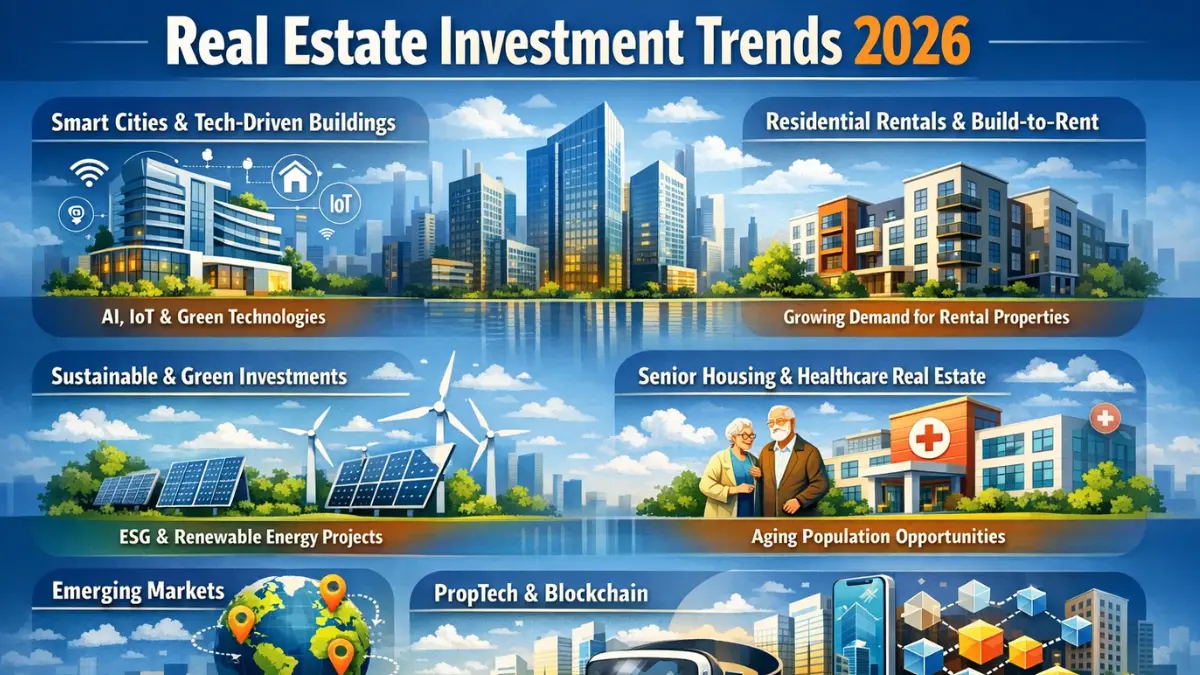
In 2026, real estate investment trends in India and the United States reflect both long-term structural shifts and short-term adjustments as markets navigate evolving demand, financing conditions, technology adoption, and demographic changes. While both countries present compelling opportunities, differences in maturity, asset focus, and capital flows shape distinctive investment environments.
India: A Growing, Institutionalizing Market
1. Strong Institutional Investment Momentum
India’s real estate sector in 2026 is poised for continued institutional investment growth. According to industry analyses, institutional inflows are expected to remain strong at approximately USD 5 billion to 7 billion annually, supported by stable fundamentals and improving investor confidence.
Key drivers in India include:
- REITs and listings (IPOs): A growing number of Real Estate Investment Trusts, small & medium REITs, and company IPOs are democratizing access to real estate capital markets, bringing in diversified investor participation.
- Foreign and domestic capital: Cross-border investment is gaining traction as India’s growth story and demographic tailwinds attract global capital.
- Shift to varied asset classes: Beyond traditional office and residential properties, industrial & warehousing, data centers, alternatives like co-living, senior housing, and mixed-use developments are seeing increased interest.
- Sustainability and technology integration: ESG (Environmental, Social, Governance) compliance and tech-driven building standards are influencing investment decisions, especially in prime and commercial segments.
2. Diversification & Emerging Asset Types
India’s investment trends in 2026 are not limited to conventional real estate:
- Industrial and Logistics: Rapid e-commerce growth and supply chain modernization are fueling industrial real estate demand.
- REIT penetration: Although still emerging compared with global markets, REIT adoption is expected to grow further, potentially reaching 25–30 % penetration by 2030 — suggesting robust long-term institutional interest.
- Tier-II & Tier-III markets: Smaller cities are gaining attention due to improved infrastructure and better affordability.
3. Residential Demand & Price Outlook
Residential investment remains resilient in India:
- Surveys show most developers expect housing prices to rise by more than 5 % in 2026, driven by solid demand across segments.
- Increasing interest from NRIs and local wealth accumulation continues to support premium and luxury residential demand.
4. Policy & Financing Support
Regulatory support, including proposed central bank guidelines for lending to REITs, aims to enhance liquidity and financing depth in the real estate sector.
India’s overall investment outlook for 2026 suggests a maturing market that’s diversifying beyond historical norms, integrating institutional capital structures, and opening new channels for both local and global investors.
USA: Stabilizing & Diversifying Investment Landscape
1. Commercial Real Estate Rebound
U.S. real estate investment in 2026 is showing signs of recovery and momentum, especially in commercial sectors:
- Commercial real estate investment activity is expected to increase by around 16 % in 2026 to approximately USD 562 billion, approaching pre-pandemic annual volumes.
- Leasing activity across offices, industrial, retail, and multifamily sectors is anticipated to improve after recent volatility.
Investors are focusing on prime institutional assets, with scarcity of high-quality space and strategic selection becoming key drivers of returns.
2. Sector Divergence & Emerging Niches
The U.S. market in 2026 reflects a sectoral divergence:
- Office real estate shows varied performance; newer, high-quality buildings are recovering faster than secondary spaces.
- Industrial & logistics space continues to benefit from e-commerce growth and supply chain reshoring.
- Data centers and multifamily assets attract strategic capital due to structural demand and the rise of technology-driven industries.
- Retail and hospitality demonstrate resilience through disciplined development and tenant expansion.
3. Residential Investment Dynamics
While commercial investment is gaining pace, residential investment trends in the U.S. show a more balanced or gradual growth trajectory:
- 2026 forecasts indicate moderate increases in sales and price stabilization, offering steady opportunities for long-term buyers and rental investors.
- Rental markets and multifamily demand, particularly in markets with strong job growth, continue to attract capital.
4. Capital Markets & Investor Sentiment
Reports highlight improving investor confidence in U.S. real estate due to stabilizing macroeconomic factors and the prospect of phased interest rate adjustments.
Additionally:
- Gateway and high-growth metropolitan markets (e.g., Dallas-Fort Worth, Miami, Brooklyn) are expected to outperform due to strong real estate prospects.
- Technology integration in real estate, including data analytics and smart infrastructure, is influencing investment decisions.
Overall, the U.S. outlook for 2026 suggests a gradual recovery in real estate investment activity, with commercial growth leading the charge while residential and niche sectors maintain steady interest.
Comparative Outlook: India vs. USA
| Aspect | India (2026) | USA (2026) |
|---|---|---|
| Investment Growth | Steady institutional inflows with new REIT expansions. | Commercial investment recovery ~16% increase. |
| Asset Focus | Diversification into industrial, warehousing, alternatives. | Sectoral growth in offices, industrial, data centers. |
| Residential Investment | Strong demand with price growth expectations. | Steady residential demand with slower, balanced growth. |
| Market Depth | Growing REIT and IPO participation; emerging Tier-II/III markets. | Mature capital markets with focused strategic asset plays. |
| Investor Sentiment | Rising confidence and sustainability influence. | Improving sentiment with cautious optimism and diversified flows. |
Conclusion
India’s real estate market in 2026 offers high-growth potential with expanding institutional participation, diversification into industrial and alternative assets, and a maturing REIT ecosystem that broadens investment access.
The U.S. market, by contrast, is navigating a recovery phase, with commercial real estate investment leading growth and residential assets offering steady risk-adjusted returns. Both markets provide unique opportunities: India as a rapidly evolving frontier with long-term migration and urbanization dynamics, and the U.S. as a diversified, mature investment landscape with robust capital flows and structural demand drivers.
Investors should consider risk tolerance, investment horizon, and asset class preferences when evaluating where to allocate capital — balancing growth potential with stability and income generation.