

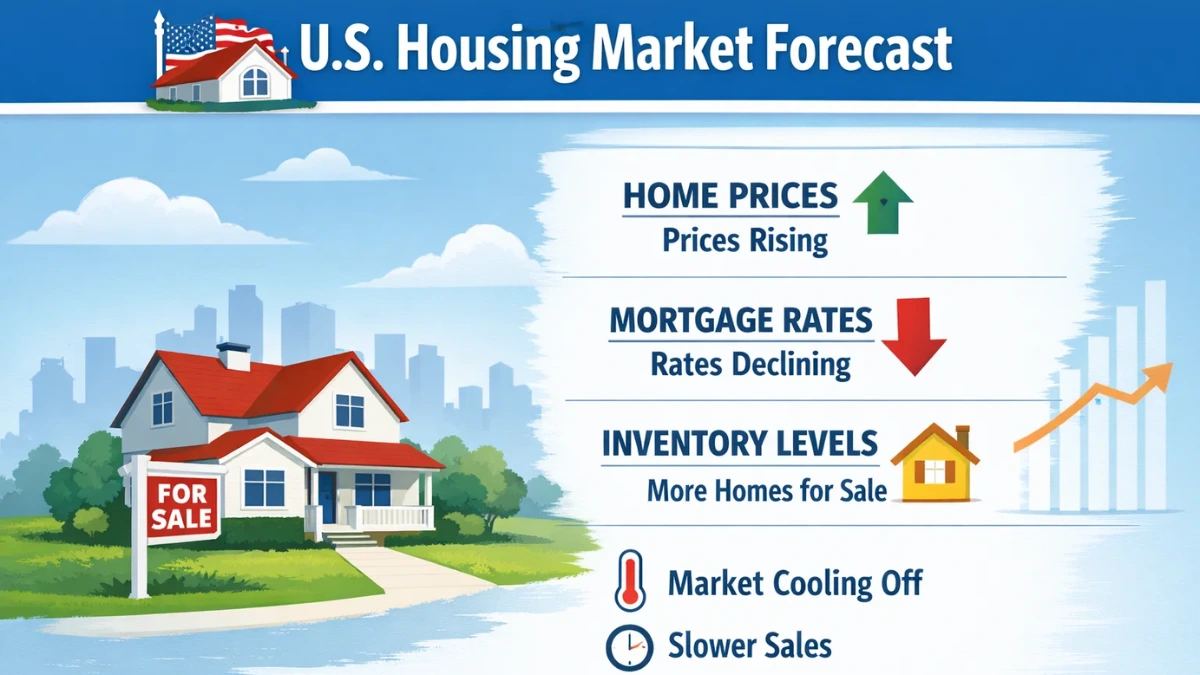
The U.S. housing market enters 2026 at a pivotal moment. After several years of rapid price appreciation, rising mortgage rates, and limited inventory, the market is gradually transitioning toward balance. Buyers are adjusting to higher borrowing costs, sellers are becoming more realistic about pricing, and homebuilders are responding with targeted supply strategies.
In 2026, the key themes shaping the housing landscape are mortgage rate stabilization, modest price growth, improving inventory, and steady but not explosive sales activity. Let’s explore what experts predict for prices, home sales, regional trends, and the broader outlook for the year ahead.
Overview of the U.S. Housing Market in 2026
The housing market in 2026 is expected to show signs of normalization rather than dramatic shifts. After the pandemic-driven boom and subsequent affordability squeeze, conditions are gradually stabilizing.
Mortgage rates are projected to fluctuate within a moderate range compared to the peak levels seen earlier in the decade. While rates may not return to historic lows, slight easing or stability is expected to encourage more buyers to re-enter the market. This could unlock pent-up demand from households that delayed purchases in 2023–2025.
Inventory levels are also anticipated to improve modestly. Many homeowners who previously held onto ultra-low mortgage rates may begin listing properties as life events, job changes, and family needs outweigh rate concerns.
Home Price Forecast for 2026
Home prices in 2026 are forecast to grow at a slower, more sustainable pace compared to the rapid increases seen earlier in the decade.
Most analysts predict national home price growth in the low single digits, typically between 3% and 5%. This moderation reflects a better balance between supply and demand. While inventory remains tight in many regions, it is no longer at extreme lows.
Several factors are influencing price trends:
Affordability constraints continue to limit how much buyers can pay.
Higher mortgage rates have reduced purchasing power.
Wage growth is helping offset some affordability challenges.
Limited land supply in certain metros supports price stability.
Rather than widespread price declines, most markets are expected to experience modest appreciation. However, regional variation will remain significant, with some markets outperforming others.
Home Sales Predictions for 2026
Existing home sales are expected to increase slightly in 2026 compared to previous years, though volumes may remain below long-term historical averages.
The key driver behind rising sales activity will be improved mortgage rate stability. Even small reductions in rates can significantly impact monthly payments and buyer confidence. As a result, more first-time buyers and move-up buyers may re-enter the market.
New home sales could perform relatively better than existing homes. Builders have been offering incentives such as mortgage rate buydowns, closing cost assistance, and flexible financing options. These strategies may continue to attract buyers who find resale inventory limited or overpriced.
Overall, 2026 is projected to bring steady, gradual improvement in transaction volumes rather than a sharp surge.
Mortgage Rate Outlook
Mortgage rates remain one of the most important variables in the 2026 housing forecast. After peaking in earlier years, rates are expected to stabilize, with potential for slight downward movement depending on inflation and Federal Reserve policy.
If inflation remains under control and economic growth moderates without entering recession, mortgage rates could settle into a manageable range. This would support steady demand while preventing overheating in the market.
However, significant rate spikes remain a risk factor. Economic uncertainty, global events, or inflation surprises could disrupt forecasts and impact buyer sentiment.
Regional Housing Market Trends
Real estate remains highly local, and 2026 will be no exception. Some regions are positioned for stronger growth than others.
Sun Belt markets may continue attracting buyers due to population growth, job opportunities, and relatively lower housing costs compared to coastal metros. Cities in Texas, Florida, Arizona, and the Carolinas could see steady demand.
Midwestern markets may experience stable appreciation driven by affordability and limited overbuilding. These areas often attract first-time buyers and families seeking lower cost of living.
High-cost coastal markets may see slower price growth due to affordability pressures. However, limited land availability and strong local economies will likely prevent sharp price corrections.
Demand Drivers in 2026
Several long-term factors continue to support housing demand in the United States.
Millennials remain a major force in the housing market as they enter peak homebuying years. Generation Z is also beginning to enter the market, increasing demand for starter homes and affordable properties.
Remote and hybrid work models continue to influence buying patterns. Many households are prioritizing larger homes, flexible office space, and suburban or secondary markets over dense urban cores.
Additionally, demographic growth, household formation, and steady employment levels are supporting long-term housing demand.
Challenges Facing the Market
Despite positive signals, challenges remain in 2026.
Affordability is still a major concern. Even with slower price growth, high home values combined with elevated mortgage rates limit purchasing power.
Inventory shortages persist in certain markets, particularly in affordable price segments. Many entry-level buyers continue to face stiff competition for limited listings.
Construction costs and labor shortages also impact new housing supply. Builders must balance affordability with profitability, which may limit how quickly new inventory can come online.
Investment Outlook for 2026
For investors, 2026 presents a more stable and predictable environment compared to the volatility of previous years.
Rental demand remains strong, especially in growing metropolitan areas. Higher mortgage rates have pushed some households into renting longer, supporting rental price stability.
Single-family rental investments, multifamily properties, and properties in high-growth suburban areas may offer solid long-term opportunities. However, investors must carefully evaluate local market fundamentals rather than relying on national averages.
Flipping activity may be more challenging in slower-appreciating markets, requiring disciplined pricing and cost control.
Future Predictions Beyond 2026
Looking beyond 2026, the housing market is expected to continue evolving toward equilibrium. Extreme price surges are unlikely without major economic shifts. Instead, gradual growth aligned with income trends appears more sustainable.
Technological innovation, digital transactions, and AI-driven property valuation tools may further streamline the buying and selling process. Sustainability and energy-efficient homes are also expected to become more important to buyers.
Over time, housing supply will need to increase significantly to meet demographic demand. Policy reforms and zoning changes may play a crucial role in shaping long-term affordability.
Conclusion
The USA housing market forecast for 2026 suggests a year of stabilization rather than dramatic expansion or decline. Home prices are expected to rise modestly, sales volumes may gradually improve, and mortgage rates are likely to remain a key influence on buyer behavior.